
How many restrooms does a marathon or race need in Meads?
Start with runner count, then split it by location. A start line with 500 people milling around for 30 minutes needs more capacity than a finish chute where people keep moving. How Many Porta Potties Do I Need in Meads, KY walks through the math event by event, but the short version: cluster units at the start, thin them at aid stations, and load up again at the finish. Under ADA Standards section 213.2, where single-user units are clustered you need at least 5 percent accessible, never fewer than one. That means even a modest cluster of six or eight standard units needs an ADA accessible porta potty sitting right next to them, not tucked around a corner. For a half marathon or 5K with a single loop course, most race directors in Meads lean on standard porta potty rental units at the aggregate points and skip mid-course units unless the loop is long. Bigger races, festivals attached to a race weekend, or anything with a beer garden after the finish usually add a deluxe flushable porta potty or two near the VIP or sponsor tents. If your race shares a weekend with a festival restroom rental setup or a concert stage, plan the counts together so trucks aren't crossing paths on race morning. We also handle marathon and race restrooms for courses that cross into Lyndon, about 1.9 miles southwest of Meads, or loop toward Anchorage, 3.0 miles east, so the whole route stays covered.
What about power for timing tents and finish line equipment?
Timing chips, PA systems and finish line clocks all need reliable power, and a generator failure at mile 26 is not the moment to find out your setup was shaky. A temporary power pole gives you a fixed 200 amp service point instead of daisy-chaining cords from a generator across a wet field. Knowing how to brace a temporary power pole matters here: a pole set on soft turf or gravel needs guy wires or a braced base plate staked at all sides, because a pole that leans under load can pull the whole feed loose mid-race. We set poles on compacted ground where possible, run guy wires at three or four points, and brace against the pull direction of the heaviest cable run, usually toward the timing tent. Pair the power setup with a light tower rental if your race starts before sunrise, which is common for summer half marathons trying to beat the heat. For GFCI protection on any cord run near water stations or misting tents, OSHA 1926.404(b)(1)(ii) is the standard our crews follow on setup, even though it's written for construction sites. If your finish line sits near a road crossing, crowd control barrier rental and temporary fence rental keep spectators off the course without blocking sightlines for photographers.
Where should restrooms go on a race course?
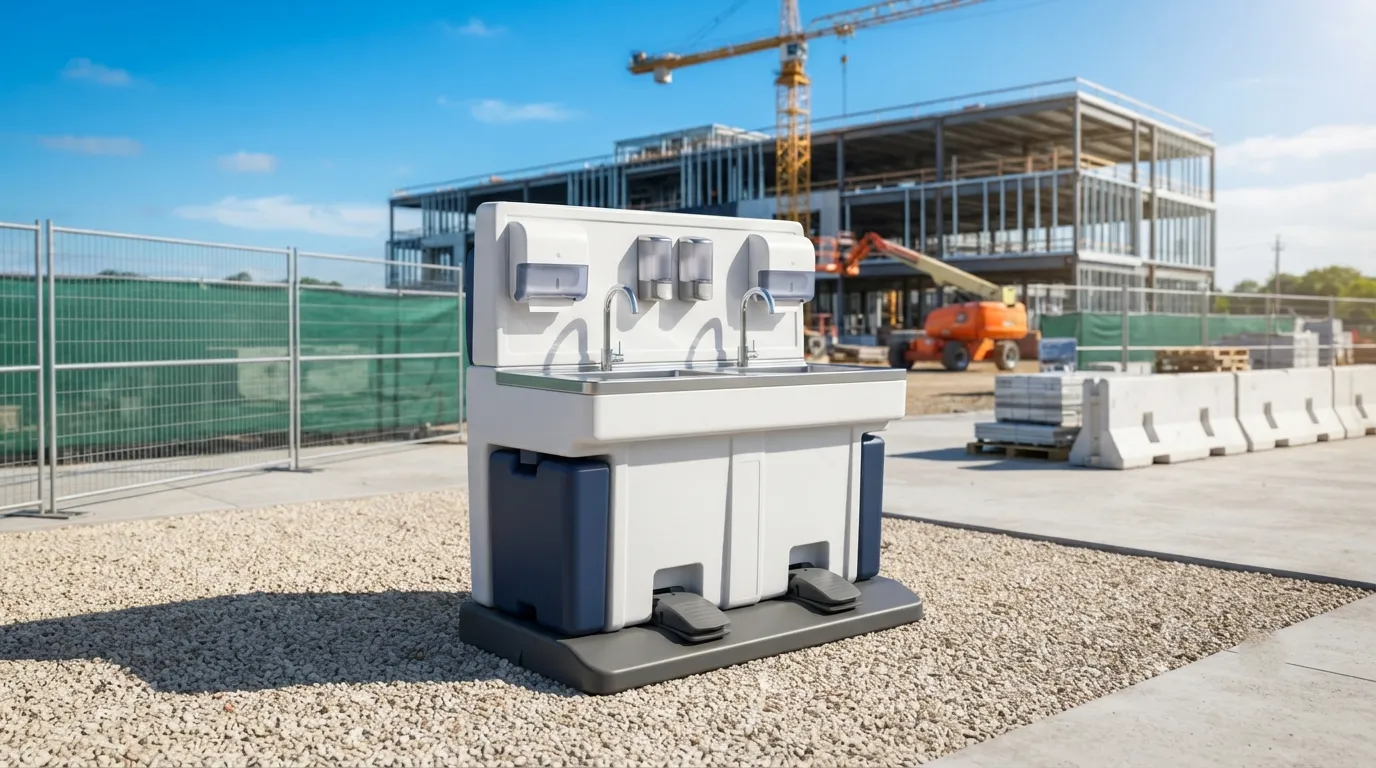
Start line, every aid station past mile 6, and the finish chute, in that order of priority. OSHA 1926.51(c) sets the baseline ratio most race sanitation plans borrow from, even though it was written for job sites: one toilet for every 20 workers, scaling up from there. Race crowds don't map perfectly onto that table, but it's a reasonable floor for a course with volunteers and staff stationed at each checkpoint. The porta potty placement guide covers ground clearance and slope, but for race day specifically: keep units at least a few feet off the running lane so a spooked runner doesn't clip a door, and never block a wheelchair racer's line to the accessible unit. A standard unit runs about 44 by 48 inches on the ground and stands roughly 92 inches tall, small enough to tuck behind a tent without eating into runner corridors. For courses that finish near Meadow Vale, 1.9 miles north of Meads, or wind through Rolling Hills, 2.8 miles northwest, we scout the actual road shoulders before delivery day so nothing gets dropped somewhere a course marshal has to move it. If your race includes a post-run festival, look at event restroom rental for combined pricing instead of running two separate orders.
How much does restroom rental cost for a race weekend?
A standard unit for a weekend event runs 125 to 400 dollars depending on count and add-ons, while an ADA unit for the same weekend runs 199 to 300 dollars. Multi-unit race orders often qualify for the event-day pricing tier rather than daily rates. See porta potty rental cost for the full breakdown.
Do we need an accessible unit if our race has a wheelchair division?
Yes. ADA Standards section 213.2 requires at least one accessible unit in any cluster, and a wheelchair division makes that non-negotiable at both the start and finish. Check ADA restroom requirements for placement and clearance details.
Can Meads Porta Pros service units mid-race if the course is long?
Yes, our route trucks can hit aid stations between the start and final mile marker without disrupting runners. Talk placement through on porta potty placement guide before locking your course map.
What happens if weather forces a last-minute restroom order?
Call emergency porta potty rental and we'll move units same day where the route allows. Storms and heat advisories are the two most common triggers for late race-day changes.
Should we order restrooms separately for the race and the after-party?
Not usually. Combining them under one event restroom rental order simplifies delivery and pickup, and often costs less than two separate bookings across the same weekend in Meads.
Next step
Get a delivery date
Tell us the address, the dates and the headcount. We size the order and confirm the route.